Landscaping to Reduce Wildfire Risk: A Firewise‑Inspired Guide for Homeowners
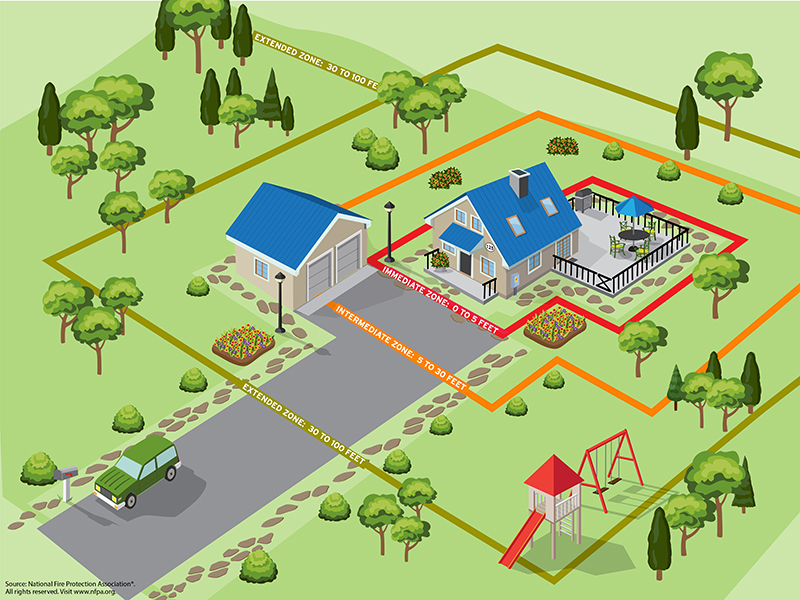
Wildfire protection scientists keep repeating one big takeaway: what burns a house is usually the yard immediately around it, not the distant flames you see on TV. The National Fire Protection Association (NFPA) calls this the Home Ignition Zone (HIZ) and breaks it into three rings that you can actively manage.(nfpa.org)
Below is a homeowner‑friendly playbook—drawn from NFPA Firewise, CAL FIRE’s defensible‑space rules, and recent FEMA guidance—explaining what to do, where, and why so your landscape helps your home survive the next red‑flag day.
1 Start With the Zones
| Zone | Distance from structures | Core Objective |
|---|---|---|
| Zone 0 – Immediate | 0–5 ft | Keep embers from igniting anything. |
| Zone 1 – Intermediate | 5–30 ft | Make it Lean, Clean & Green to slow fire spread. |
| Zone 2 – Extended | 30–100 ft (plus to property line) | Reduce fuel so flames stay on the ground and lose energy. |
(Some western states call Zone 0 the “Ember‑Resistant Zone” and are moving toward making it law.)(readyforwildfire.org, fema.gov)
2 Zone 0 (0–5 ft): Your Non‑Combustible Buffer
- Ground cover: Swap bark or rubber mulch for gravel, decomposed granite, pavers, or a concrete mow‑strip.(readyforwildfire.org)
- Plants: Ideally, none. If aesthetics demand greenery, use tiny, well‑watered succulents in ceramic pots—not wooden planters—and keep them off exterior walls.
- Structures & clutter:
- Store firewood, recycling bins, patio cushions, and BBQ propane outside Zone 0.
- Replace wooden fences or gates that touch the house with metal or masonry for the first 5 ft.
- Overhead hazards: Prune any branch within 10 ft of the roof, chimney, or deck. Keep gutters free of needles and leaves.(readyforwildfire.org)
Pro tip for desert/high‑elevation homes (hello, Sedona!): Gravel xeriscaping is both fire‑safe and drought‑resilient—no trade‑off required. Keeping the first 5 feet away from the house free of combustible materials is an ideal strategy for wildfire protection.
3 Zone 1 (5–30 ft): Lean, Clean & Green
- Vegetation spacing
- Horizontal: Break continuous fuel by creating small “islands” of shrubs or ornamentals; maintain at least 10 ft between tree crowns.(readyforwildfire.org, basc.pnnl.gov)
- Vertical: Limb up trees so the lowest live branch is ≥ 6 ft above the ground or 3× the height of adjacent shrubs (whichever is greater) to prevent ladder fuels.(readyforwildfire.org)
- Irrigation & maintenance
- Keep turf or ground‑covers green and under 4 inches tall.
- Remove dead leaves, pine needles, and pruning debris at least once a month during fire season.
- Plant selection
- Favor low‑resin, high‑moisture species (think deciduous rather than juniper, agave rather than rosemary).
- Group similar plants together; isolated plantings are easier to defend.
4 Zone 2 (30–100 ft +) : Reduce Fuel, Lower Flame Length
- Thinning: Increase spacing between tree clumps; on gentle slopes, aim for ≥ 12 ft between crowns—more on steeper terrain.(readyforwildfire.org)
- Surface fuels:
- Mow or string‑trim grasses to ≤ 4 in.
- Chip slash piles and scatter mulch thinly (≤ 3 in.) or remove it altogether.
- Wood piles & outbuildings: Keep them at least 10 ft clear to bare mineral soil in every direction.
Tip: A winding decomposed‑granite path, dry‑creek swale, or veggie garden can double as an attractive fire‑break in this wildfire protection zone.
5 Choosing “Fire‑Smart” Plants & Materials
| Opt For… | Avoid… |
|---|---|
| Leaves with high moisture (e.g., native oaks, Aspen, Redbud) | Fine, oily needles (junipers, cedars, pines near the house) |
| Low, open‑structured shrubs (salvias, manzanita cultivars kept pruned) | Tall, dense shrubs (Italian cypress, ornamental grasses in Zone 1) |
| Inorganic mulches within 5 ft | Shredded bark mulches against siding |
| Hardscaping accents—boulders, rock mulch, flagstone patios | Wooden retaining walls that touch the house |
(Plant flammability lists vary by region; always cross‑check with local Cooperative Extension.)
6 Seasonal Maintenance Checklist
| Season | Key Tasks |
|---|---|
| Spring | Clean gutters, test irrigation, replace mulch with fresh mineral cover, prune winter die‑back. |
| Summer | Mow grasses regularly, deep‑water fire‑resistant plants to keep them lush. |
| Fall | Remove leaf litter, thin tree canopies, schedule arborist visit. |
| Winter | Chip slash piles, update evacuation routes, plan any hardscape changes. |
7 Beyond the Yard: Community & Code
Joining—or starting—a local Firewise USA® site can unlock grants, chipper days, and insurance discounts. Check your county or state for additional defensible‑space ordinances; some jurisdictions (e.g., parts of California) now require a hardened Zone 0.(readyforwildfire.org, fema.gov)
Final Takeaway
A fire‑smart landscape isn’t about stripping your yard bare—it’s about strategic design, plant choice, and ongoing care. Start at the house, work outward, and remember: a weekend of pruning now beats months of rebuilding later.
Need help crafting a Firewise landscape plan or retrofitting an existing garden? Let’s talk—professional guidance can turn these best practices into a beautiful, site‑specific design that protects both your home and your peace of mind.
Sources: NFPA/Firewise USA, CAL FIRE “Defensible Space” guidelines, FEMA Homeowner’s Guide to Defensible Space, PNNL Building America Solution Center.